Hi it’s Lulu here with another post (finally)!
It took all this time, but on this last day of modules, I finally entered my element with…the brain!! Sheila also entered one of her many elements in the afternoon by teaching about linguistics and language development! Overall, a big brain day—I’ll write about the morning and Sheila will continue for the afternoon!
Preparing for this morning was challenging but fun because there was so much that I wanted to teach about the brain. Before, when I told students that I study neuroscience at college, some seemed unsure about what that entailed. So, on this day, I showed them some amazing applications of neuroscience, from understanding emotions to building neural prosthetics. Through planning this lesson, I feel like I rediscovered my own excitement for neuroscience! It’s so amazing what we can do with our knowledge about the brain.
During class, I sometimes have trouble gauging the students’ understanding as the teacher up front. There are always lots of side conversations because the other teachers are busy explaining, translating, and checking the students’ comprehension, but it’s hard to tell what they are talking about. I like having us all at different tables though because we can coordinate together to control the pace of the class in a way that suits the students. I had a hard time getting used to calling on students because I personally hate being called on, but it is actually a great tool to keep the class engaged. I’d like to think we are close enough with our students so that calling on them is not completely uncomfortable (??). Some students may disagree though… We often ask students to translate English sentences to Korean, which is good especially for the students who specifically want to learn more English.

Size of a frog’s brain (shoutout Crime Day) vs. a human (Billy Bob’s) brain 
We had the students guess why the human brain looks the way it does
This day was pretty lecture heavy, as we learned about the basic structure of a neuron and how action potentials are like the electricity we explored earlier this week. Although we had them filling out a worksheet, to further wake the students up, we demonstrated that “neurons that fire together wire together” (catchphrase credit to my Intro to Neuroscience class) by jumping all together and also jumping all out of sync. I think they understood this metaphor (and hopefully didn’t just think we were randomly jumping). After that, we learned about the different lobes of the brain, and then delved into a favorite topic of the teachers’: the homunculus! This strange word describes a morphed human figure where each body part’s size is proportional to its sensitivity in the motor/somatosensory cortex. This handsome fellow became dear to our hearts while we were preparing our lessons, and we had the students construct with clay what they thought the homunculus would be. I think some of the students had trouble fully understanding this concept, but we still got some interesting clay creations (although some students were resistant to the clay because it gets hands dirty) and we teachers could happily see our friend the homunculus.
After, we talked about lateralization of the brain, aka the specializations of our left and right hemispheres, and how the left is responsible for language. I wanted to introduce the idea of the corpus callosum, a bridge that connects both sides of the brain and allows them to communicate with each other. I think the students understood these concepts, especially that visual information from one side goes to the other side of the brain. This stuff is so cool to me!! I tried my best to use maximum energy for this module, and it definitely was higher than when I taught Materials or anything else. Sheila, Lexi, and Sarah said I sounded like Dora, which is interesting…but I’ll take it. I’m really realizing the importance of teaching something that you’re passionate about. Not that I didn’t enjoy the other modules, but this day definitely felt better. After lunch, we watched some really cool split brain patient videos (that were unfortunately also really low quality) and talked about why a split brain might occur (answer: the severing of the corpus callosum is used to treat epilepsy). Talking about the different parts of the brain and language perfectly segued into Sheila’s lesson about linguistics and language development!
________________
(Sheila here—back on campus and hellbent on getting the blogs finished)
The afternoon continued with the Brain, where Lulu talked about the different lobes (Lulu 쌤 went above and beyond once again), including those relating to language (Wernicke’s and Broca’s Region).
Which transitioned to—Linguistics! (Thank you Profs. Suzanne Flynn and Adam Albright for the inspiration!)
This was sort of a last minute addition to the workshop as we brainstormed for Brain Day (get it? Brainstorming for brain day… hahahaha my puns are only appreciated by my teammates), but seemed especially fitting since we had a group that spoke three languages: Korean, Chinese, and English (to a certain degree).

First we learned about language acquisition (relevant since everyone in the room was learning one of the three languages mentioned above) in infants—and I was relieved to see that the students were at least entertained by the babies cooing, babbling, and speaking in sentence fragments. We then learned about the parts of the mouth responsible for producing phonemes, or sounds of language. The students were let loose on http://www.ipachart.com to explore the range of sounds human mouths are capable of producing. There was a cacophony of /p/, /ŋ/, /ʃ/, /ɸ/, even some non-pulmonic sounds that none of us could make.
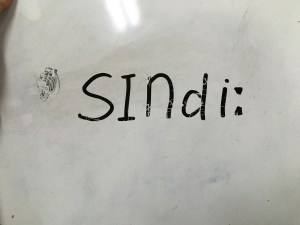
After comparing the phonemes of Korean, Chinese and English (which might inspire a few of our students to learn the International Phonetic Alphabet to learn standard pronunciation of English words), we had a competition to guess each other’s names in IPA—some were more apparent than others!
After which…
FINAL PROJECTS TIME!
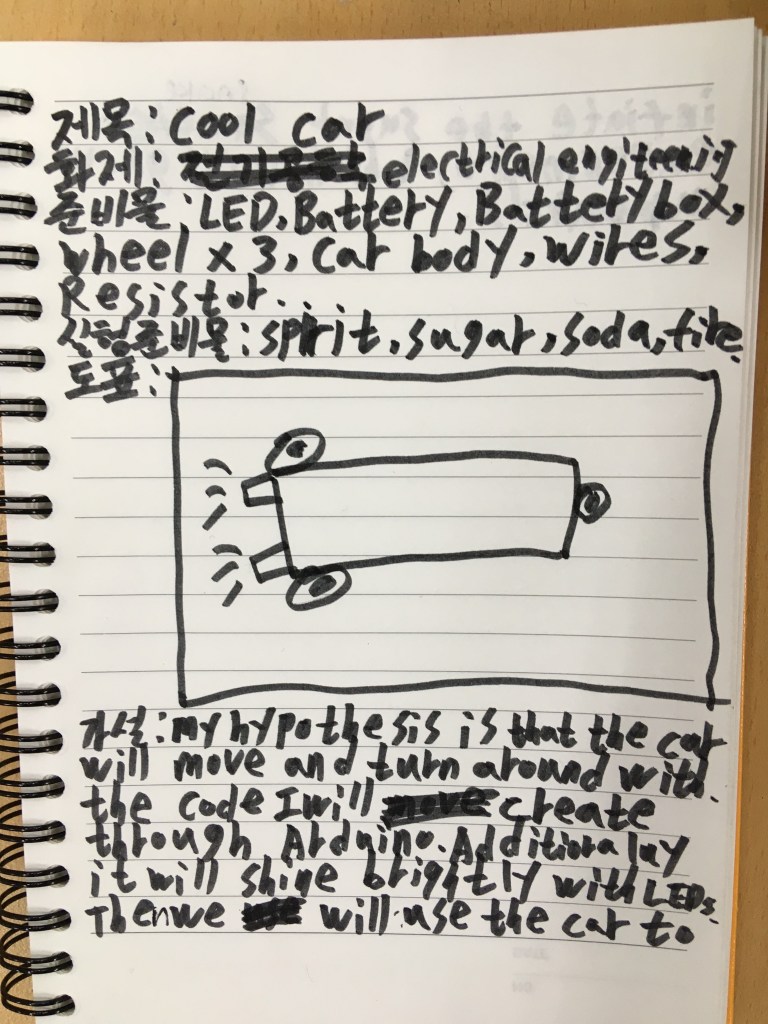
During checkouts throughout the second week we had been trying to get students to think of final project ideas by making them reflect on their favorite activities. We wanted to make the projects as individualized as possible, which came at the cost of having to scramble to get the right materials for them. There were Arduino projects, epoxy (such a big hit) projects, a bacteria project, and even a hydroponics project.
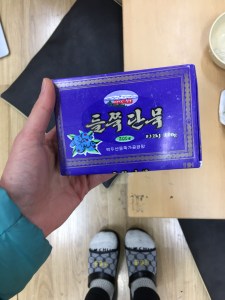
As Lulu, Lexi, and Sarah scattered across Seoul to obtain more epoxy and electronics parts, I stayed behind to clean up the classroom in anticipation for a Yeomyung School event scheduled for the next day. While cleaning, I came across a box of 들쭉단무, or bilberry jelly, that George Washington had brought to class. Bilberries are similar to blueberries, and the package claimed that the bilberries had come from the shade of 백두산, the iconic mountain that straddles the border between North Korea and China. I wasn’t sure how such an item would make its way out of North Korea, and recalled George saying that he had never eaten it in the North either.
These small reminders that catch me off guard remind me of the audience we are teaching.
 GTL Korea 2020
You girls are absolutely amazing. Teaching in such an environment is challenging and exiting at the same time. Fantastic. When you come back you are invited to teach in my house.
LikeLike