I wasn’t sure which day to put this in since it happened throughout the workshop. Something we tried this year was to incorporate an additional element of choice and “hard fun.” This is where Cubes in Space comes in! Over this past summer, I got the opportunity to witness a sounding rocket launch from Wallops Island. The nose cone of that rocket was dedicated to Cubes in Space (CiS), a global competition for students to submit experiments that can fit inside a 4 cm x 4 cm x 4 cm plastic box. While the sounding rocket is a popular option, the Cubes can also be launched in a helium-filled weather balloon that can stay in the stratosphere for hours at a time (which is what we went with!). The conditions there are remarkably similar to Mars, with temperatures of -50 °C, high levels of UV rays, and very low atmospheric pressure. We were very fortunate in being able to obtain a Cube for our students—a huge shoutout to Amber Agee deHart from CiS for letting us get a Cube in advance and for being so helpful with our questions!
Now back on Earth…
At the end of Day 1 (space and satellites!) of the science workshop, a survey was sent out for students who might be interested in CiS—I was a little nervous that no one might be interested (especially since the balloon would not be launched until October/November, and the Cube not returned till around January next year), but was relieved to find responses from George Washington, Hank, Daniel, Grace, and Kitty!
After a couple of attempts at trying to meet during lunch time to talk about the experiments (eating 마라탕 took too much time out of lunch), the students and I ended up using KakaoTalk as the primary means of communication. It still amazes me how our students, especially those who came directly from North Korea, are so seamlessly integrated into social media.
Initially, the experiment proposals were mainly one-word phrases like “rubber band,” “hair,” or “metal.” So we spent some time expanding these subjects into lengthier proposals with hypotheses. Kitty, who wanted to look at how different materials (metal, paper, vinyl) might change in near-space environments, reworked her proposal to be “I want to send colored plastic to see how the color might change. I think the color will change because of UV rays.”
Daniel also did some reworking on his experiments as well. Initially he was also looking at how materials might change (rubber bands, wood pieces), but got interested in bacteria after Lexi’s workshop on Day 4 (Bacteria!). So we made some agar out of the Amino Lab kit, poured it into small plastic containers from Daiso, and inoculated it with some of the colorful bacteria from the Amino Lab kit. For his hypothesis, he wrote, “I wonder if ultraviolet rays in outer space would endanger bacteria.”
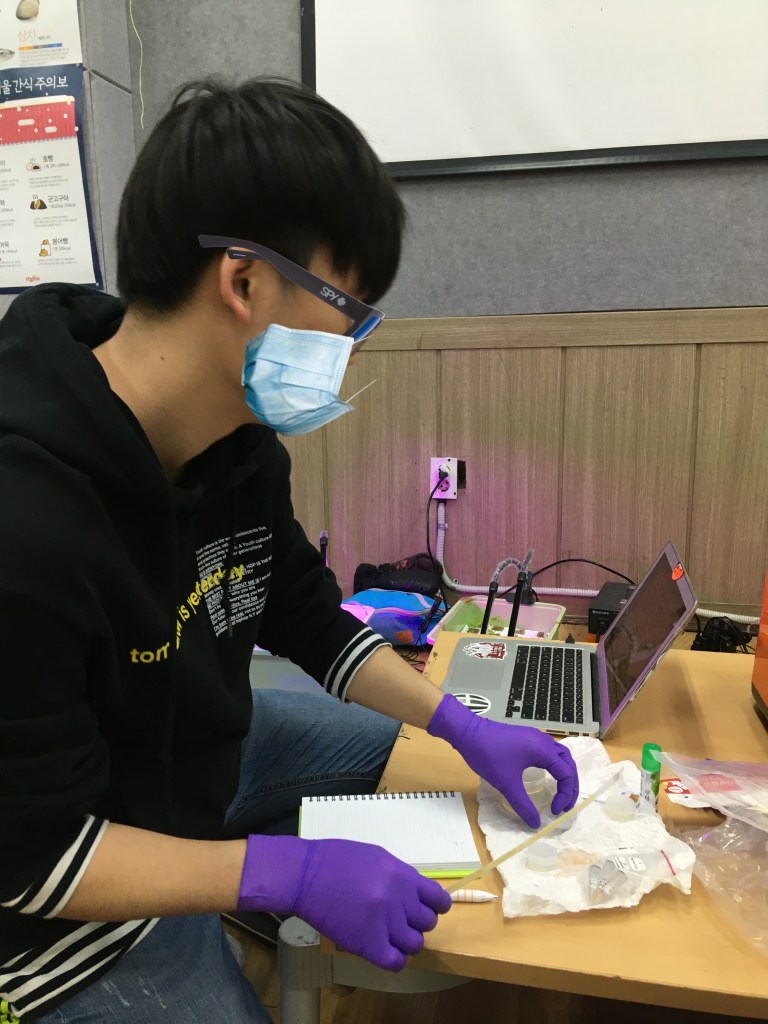
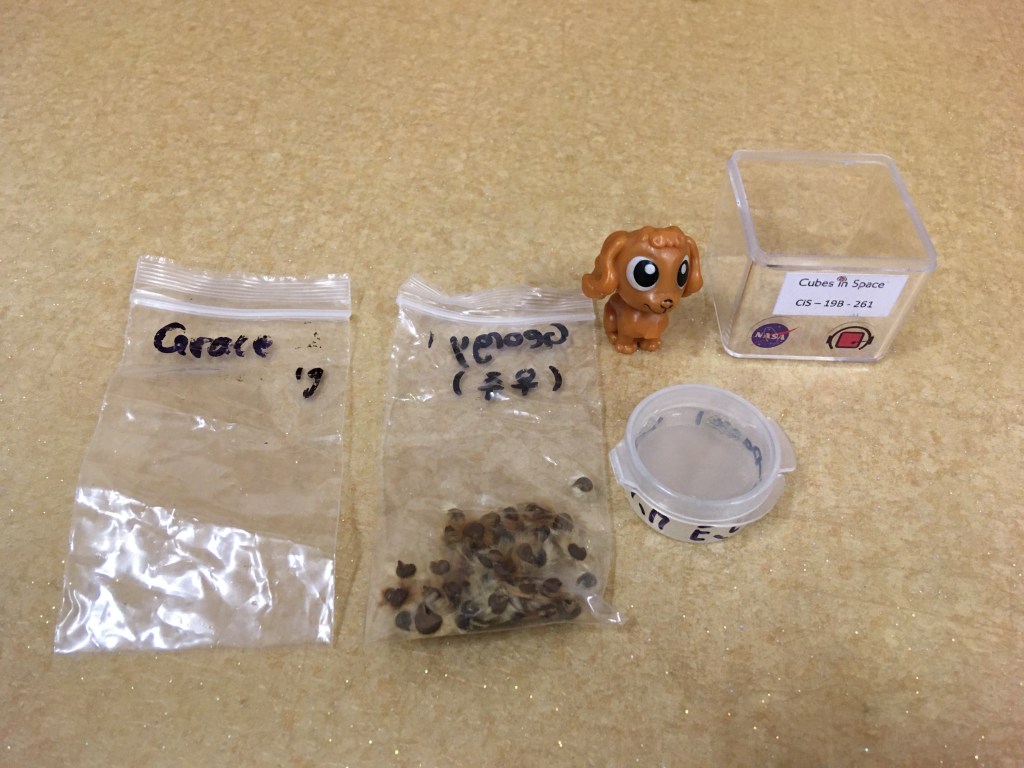
George, who is an avid soccer player, suggested testing how exercise could help with bone loss in microgravity environments. While this would have been a wonderful experiment (and currently being done by NASA on the ISS), it would have been a little difficult to do with our 4 cm x 4 cm x 4 cm space… So George decided to send a tulip to space! Unfortunately, tulips are sold as bulbs, so that turned out to be tricky too. In the end we settled with flower seeds, and in particular 무궁화, which is the national flower of South Korea. We also wanted to look into sending 목란꽃, a type of magnolia which is the national flower of North Korea—but this was a little trickier to obtain. We are still on the lookout, however! His hypothesis was that the flower seeds will do better after exposure to space environments, since mutations are often linked with better health and superpowers in science fiction… we’ll see how that turns out!
Another symbolic experiment was Grace’s. I asked her permission on sharing this with others—and she graciously said yes. Grace wanted to send tears to space, since she had heard that liquids act very differently in low pressure environments (in very low pressure and temperature, water can sublimate into gas—here is a phase diagram of water). She wanted the tears to essentially “disappear,” in the way she hoped that sad things in her life would disappear. She collected her tears in a small ziplock bag by watching emotional videos—and now we have about 0.1 g of Grace’s tears in the Cube. So light, but so heavy in meaning.
Hank wanted to build a device that could measure the Earth’s magnetic field using a Hall sensor, but unfortunately got sick during the program and could no longer participate : (
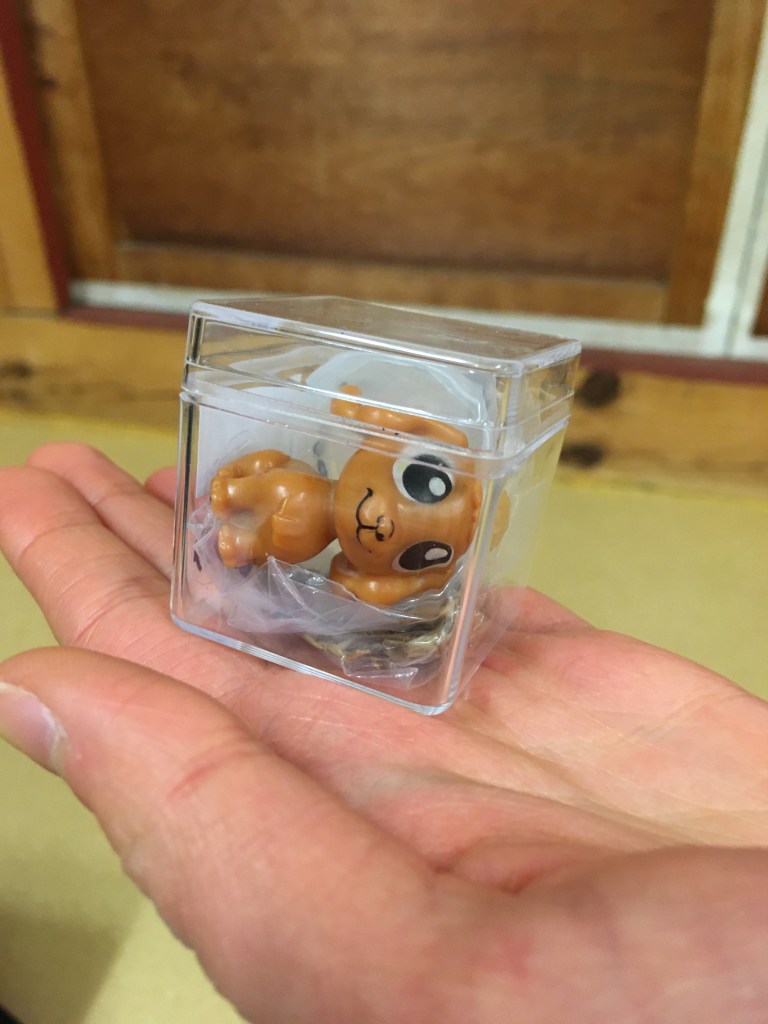
At its current state, the Cube weighs only 40g, and carries seeds, tears, bacteria, and a small plastic dog. I can’t claim that the Cube will leave a long-lasting and deep impact on our students, but for me it means so much that they went through the process of inquiry and execution of an experiment—and hope that they feel a small sense of empowerment in having sent something to space. Looking forward to seeing the results about this time next year!
 GTL Korea 2020