Hello everyone!
Sorry about the lack of updates for the last few days. The second week hit us like a giant wave and we are slowly catching up…
Saturday (1/11)
Going to the DMZ had been on our minds since the very beginning, given our situation of teaching North Korean refugees in South Korea. The DMZ is a tenuous buffer between two diametrically opposed nations and ideologies, but also hints at future coexistence and harmony. There is a section of the DMZ called the Joint Security Area (often referred to as Panmunjom) where North Korean and South Korean soldiers stand face to face. The JSA is where diplomatic talks happen between the two countries, and also straddle the physical border between the two countries. Nearby is Dorasan train station, which used to be a part of the rail that connected the North and the South. The original Dorasan station has been destroyed, but it has been rebuilt and serves as the last possible stop before the North. There is only one train per day that reaches Dorasan station, and the station mainly serves as a symbol of hope and peace.
We’d intended to visit these places, but alas—we found out that the DMZ has been closed off to tourists for the past few months. The reason?
Pigs.
For the past few months, South Korea has been actively battling against the African Swine Fever virus, which has decimated pig populations across Asia. Unfortunately this has lead to the culling of pig populations near the border, and even soldiers chasing away wild boars crossing the river into South Korea. When we first heard about ASF a few months ago, we had no idea that it would come to affect us this way.
Fortunately, there was another way we could see the DMZ. The Odusan Unification Observatory, located on the junction between the Imjin River and the Han River, confirmed with us 9 AM on Saturday that they were open despite the ASF battle raging along the DMZ.

It took 5 buses and two hours to reach Odusan, and along the way we noticed the gradual appearance of barbed wire and armed guards along the Han River. A reminder that Seoul is barely 50 km away from the DMZ.
It was shocking to see, when we stepped off the bus in Paju, the sheer natural beauty of the landscape. It still gets me how Korea can have such extremes—the frenetic frenzy of the cities and the quiet simplicity of the countryside.
The first sight that greeted us when we walked into Odusan proper was a tile display of the different Arirang variations from both the South and the North:
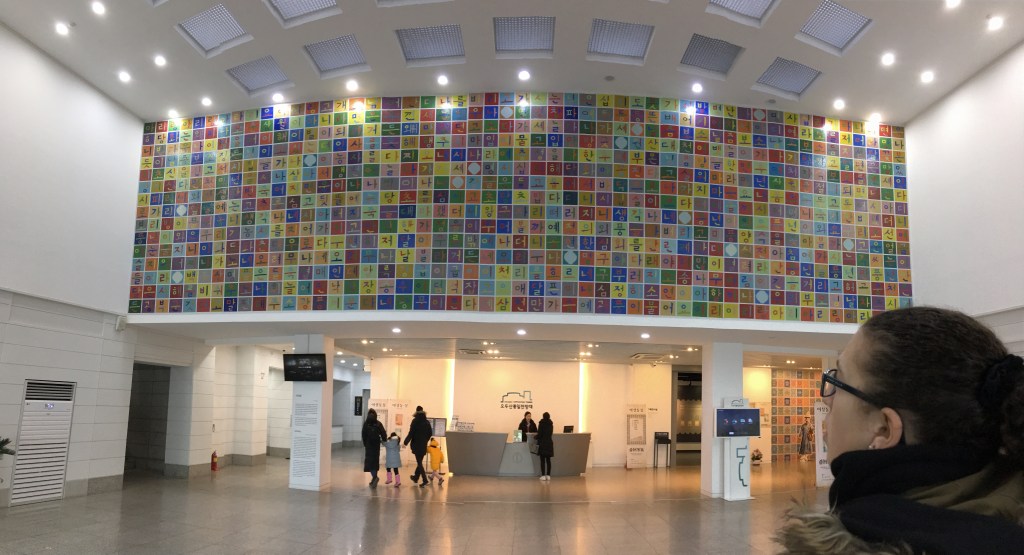
I hadn’t known that the North had a version of the Arirang as well. The North Korean version of the Arirang has references to 백두산, the tallest mountain on the Korean peninsula which straddles the North Korean-Chinese border. 백두산 appears in the South Korean national anthem and the caldera lake on the top is considered as a mystical, sacred place for the Korean people, even for those who never had the opportunity to see it in person. It’s strange to think of how despite the present seemingly unbridgeable divide between the two countries, there are thousands of years of shared history and heritage.
The topmost floors of the Observatory was… the observatory. The near 360 degree windows showed a breathtaking panorama of the Imjin River, Han River, the surrounding countryside of Paju, and of course, the North.

The two rivers seemed deceptively small and demure to serve as the marker for one of the most heavily guarded borders in the world. There were even sandbanks where birds rested (or for a person to make a run for it, if they were crazy enough to).
Odusan is incredible in that it offers a glimpse into a North Korean village across the Imjin River. While the village is likely not representative of what real villages look like in the DPRK (given that it is on the border), the fact that we could see living, breathing people walking and going about their business on the other side of the DMZ was surreal. There was even a tiny dog trotting behind someone walking near the river bank.

I felt like a voyeur looking through the telescopes, since I was pretty sure that the people on the other side didn’t have the means to peer back at us. I wondered what thoughts might go through a person living on the other side. How do they go about their daily lives knowing that they live next to one of the most heavily guarded borders in the world? What might they think of the cars and towering buildings across the river? Or that they were being constantly watched?
It felt wrong, but also I couldn’t help but feel some sort of connection—or rather, a desire to connect with the person I was watching on the other side. Perhaps there will come a day when the unnamed persons beyond the telescope might become familiar faces on the streets of Seoul.
Heading down from the observatory, we entered an exhibit featuring the drawings and maps of those who had to flee North Korea during the Korean war. Many of them were now in their 80s and 90s, but somehow remembered the intricate details of the buildings in their villages, and the layout of their neighborhood. I was especially touched by the perfume bottles containing the scents that reminded survivors of their homes—the bottles contained the scents of corn, ocean breeze, pine trees and beach roses. All seemingly ordinary scents, but never reproducible.

Another exhibit featured letters and photos exchanged between the 이산가족, the displaced and separated families between the North and the South. There was one letter written by a nephew in the North to his aunt in the South. It described a dream he had had, one where he had somehow left North Korea, bought a ticket to go to Germany, got found out that he was actually a North Korean, and escaped to Canada where he was treated like a beggar. He was disappointed when he woke up, and tried to fall asleep again, but it didn’t work.
I was amazed at how a letter like this could make its way across the border. It was so intimate, so personal, and I imagined that there was scrutiny over the contents of the letter. Family bonds tenuously maintained through paper letters. I have heard that increasingly, younger South Koreans are opposing Unification on the grounds of economic setback. The people who knew the faces and names of family members in the North are passing away, chipping away at the ties between the two Koreas. While I don’t know enough about the current political climate of South Korea, the question of Unification and coexistence seems more urgent now than ever before.

Which I supposed brings us back to our current situation of teaching at 여명학교. North Korean defectors only represent one facet of the incredibly complex issue of the North-South divide. But they are crucial in maintaining the connection between the North and the South. I cannot even begin to think of what they must have gone through (and what their parents had gone through, as is the case for our Chinese-born students) to make their way out, and to attempt to assimilate into a South Korea that is quick to notice differences.
The DMZ is a haunting reminder that borders do matter. That lines drawn on maps have consequences long after the people who drew them have died. On the way back, as the sun was setting, I noticed the brightly lit areas of Gyeonggi and Paju—and then, the pitch black spot beyond the DMZ. No lights. Not even the military posts.
 GTL Korea 2020